Learning Center
The 14% Margin Boost: Why Your 2025 Biogas Financial Models Are Obsolete
By SEO Manager & Biogas Expert at GrowDiesel · April 28, 2026
If your CBG project spreadsheet was built before 2026 policy changes, it likely underestimates returns. India has corrected the double-tax drag on blended gas and shifted project economics in favor of accurate, policy-aware models.
The death of double taxation
Under Notification No. 02/2026, the CBG portion of blended gas is excluded from the transaction value for excise calculations. This directly reduces tax leakage that older models still carry.
For blended streams, this can materially improve realization and EBITDA, especially in 5 TPD-class projects where small per-kg deltas accumulate into meaningful annual gains.
Why 2025 templates fail in 2026
Legacy sheets typically miss three shifts: the excise exclusion, the mandatory 1% blending framework (effective April 1, 2026), and CAPEX updates after the BCD cut to 0% on HDPE/LLDPE inputs.
When these are ignored, payback and IRR are usually understated, and lender-facing feasibility can look weaker than project reality.
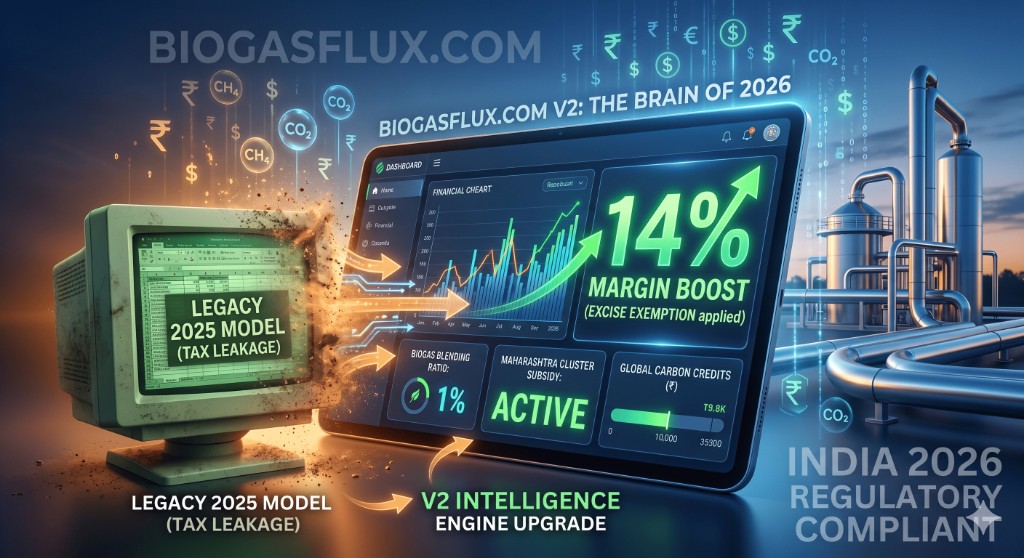
Model for the mandate era
A modern CBG model should include dynamic excise logic by blend ratio, state-level subsidy overlays (including Maharashtra incentives), and scenario checks for guaranteed offtake assumptions.
BiogasFlux V2 is designed around these 2026 policy conditions so your outputs are financing-ready rather than backward-looking.
In 2026, financial precision is strategic advantage. Update your assumptions now before outdated tax and policy logic erodes decision quality.
Try the Updated 2026 Calculator